What Is an OMR Sheet? Meaning, Format & Uses Explained
What Is an OMR Sheet? A Complete Guide for Teachers
“OMR sheet” is a term you’ll run into the moment you start preparing for a competitive exam or setting up school assessments — but what does it actually mean? This guide answers that directly: what OMR stands for, how the technology reads your marks, what a standard sheet contains, and where you’ll encounter one (NEET, JEE, school unit tests, coaching mock tests).
Already know all that and just want to make a sheet? Jump to our <a href=”https://omrsheetmaker.in/how-to-create-omr-answer-sheet/”>step-by-step generator guide</a>. Evaluating this for your school or institute? See the <a href=”https://omrsheetmaker.in/omr-solution-for-schools/”>complete OMR solution guide</a>.
What Does OMR Mean?
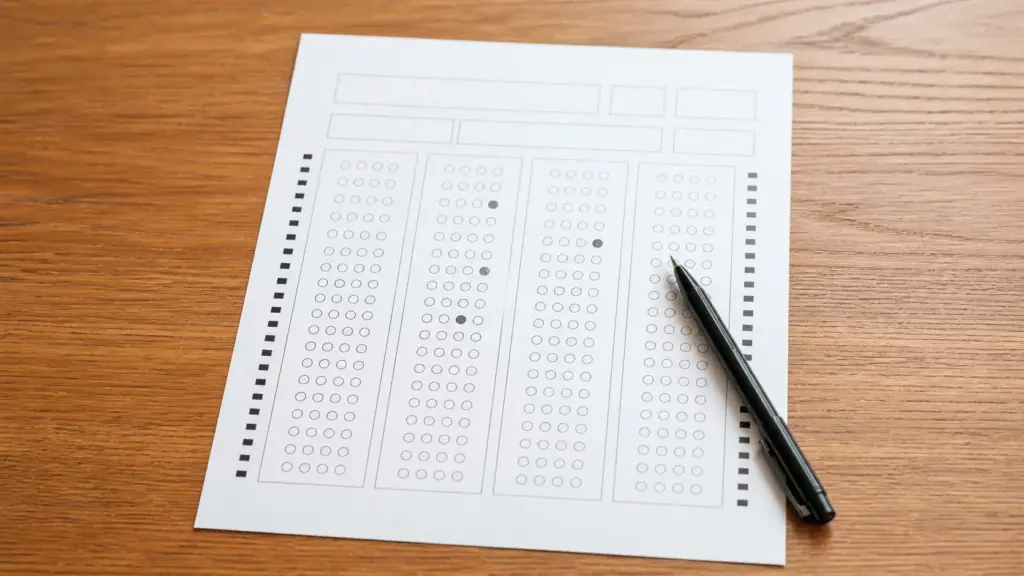
OMR stands for Optical Mark Recognition — a technology that detects human-marked data on a printed form by shining light across the page and measuring which spots reflect it differently. When you darken a bubble on an OMR sheet, that mark blocks light (or shows up as a darker pixel to a camera), and software compares the position of every darkened bubble against a stored answer key.
The result is that a page a student filled in with a pen or pencil can be scored in a fraction of a second, with no human needing to read the handwriting or interpret the mark. That’s the entire point of the format: it turns a handwritten response into something a machine can grade reliably and instantly.
OMR isn’t new — the same core idea has been used since the 1960s for census forms, surveys, and standardized testing — but it’s still the backbone of how most large-scale multiple-choice exams are graded today, because nothing else scores paper this fast at this low a cost.
What an OMR Sheet Contains
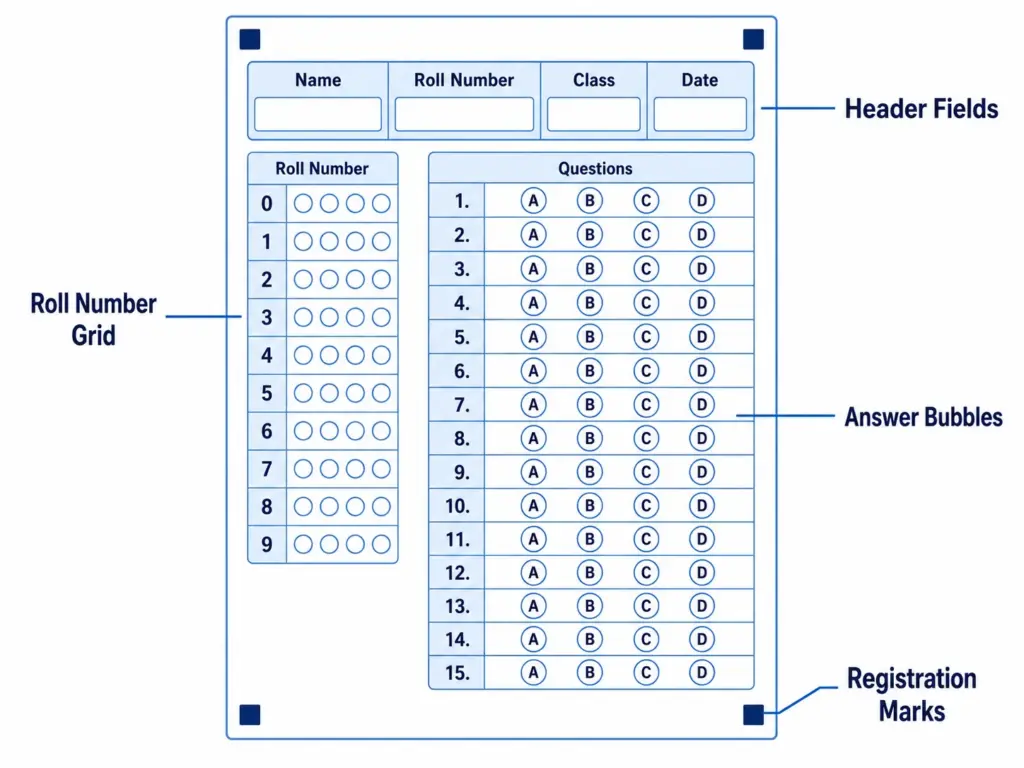
Strip away the branding and every OMR sheet — whether it’s for a school unit test or a national entrance exam — is built from the same four components:
- Header fields — name, roll number, class/section, exam date, and sometimes a subject code, usually filled in as handwriting rather than bubbles.
- A roll-number bubble grid — a column of digits (0–9) repeated for each place value, so the candidate’s ID can be read by the scanner without relying on handwriting at all.
- Numbered question rows — each question gets a row of option bubbles, typically labeled A–D or A–E, one bubble per possible answer.
- Registration (alignment) marks — small solid squares or blocks printed in the corners that tell the scanning software exactly how the page is oriented, so it can correct for a slightly crooked scan or photo.
That fixed structure is precisely why OMR sheets are machine-readable in the first place: the software always knows where to look, because every sheet generated to spec places these elements in predictable positions.
Where OMR Sheets Are Used
OMR isn’t limited to one type of exam — it shows up anywhere someone needs to grade a large volume of multiple-choice responses quickly and consistently:
- Schools use them for unit tests, terminal exams, and objective-type homework, especially in classes preparing students for board or entrance exams.
- Coaching institutes run weekly or monthly mock tests on OMR sheets to simulate the real exam experience and generate rank lists.
- National entrance exams like NEET, JEE, and various state-level CET exams use OMR at massive scale — sometimes for a few hundred thousand candidates in a single sitting — because it’s the only format that can be graded fast enough and audited afterward.
- Recruitment and government exams (banking, SSC, railways) rely on the same format for the same reasons: speed, consistency, and a physical paper trail that can be re-checked if a result is disputed.
Ready to Make Your Own?
Creating your own OMR sheet takes less than a minute on OMRSheetMaker.in — no software to install, no print shop needed. Choose your question count, add identity fields, and download a print-ready PDF or Word file.
For the full step-by-step walkthrough with screenshots, see How to Create an OMR Answer Sheet in Minutes (PDF & Word). Running this across an entire school or coaching institute? Our complete OMR solution guide covers checking, scanning, and templates too. Prefer to start from a ready-made layout? Browse our 50/100/200-question templates.
Key Takeaways
- OMR stands for Optical Mark Recognition — it reads darkened bubbles, not handwriting.
- Every sheet is built from the same four parts: header fields, roll-number grid, question bubbles, and registration marks.
- It’s used everywhere from school unit tests to NEET and JEE, because nothing else grades paper this fast.
- You can generate a free, print-ready OMR sheet — PDF or Word — in under a minute with our generator, and grade filled sheets with our answer checker.
Frequently Asked Questions
-
Is an OMR sheet the same thing as an answer sheet?
Not quite. “Answer sheet” is a general term for any page a student writes answers on. An OMR sheet is a specific type of answer sheet designed for objective (multiple-choice) questions, built with bubbles and registration marks so it can be machine-graded.
-
What does OMR stand for?
Optical Mark Recognition — the technology that detects and interprets marks made in predefined positions on a printed form, most commonly darkened bubbles.
-
Do I need a special pen to fill an OMR sheet, or will a pencil work?
Most exams require a black or blue ballpoint pen because it gives a more consistent, opaque mark than pencil, which can smudge or scan too lightly. Always check the specific exam’s instructions — some school-level tests do allow pencil for OMR sheets that will be checked manually or rechecked by hand.
-
How many questions can fit on one OMR sheet?
It depends on paper size and layout, but a single A4 page comfortably fits 100–200 questions with four or five options each. Larger question counts are usually split across a booklet or a double-sided sheet.
-
Is OMR technology outdated, or is it still widely used?
Still very much in active use. While digital and online testing has grown, OMR remains the standard for large offline exams — NEET, JEE, and most government recruitment tests — because it’s cheap, doesn’t require every candidate to have a device, and produces a physical, auditable paper trail.